
When the Darkness Comes Early — A Guide to Seasonal Depression
When the Darkness Comes Early — A Guide to Seasonal Depression
4.75 / 5.0
(4) 4 total reviews
Couldn't load pickup availability
When the Darkness Comes Early
A Guide to Seasonal Depression
Amara's Story
Amara used to joke that she was a "winter person."
She'd say it every October when the darkness started creeping in early over Reykjavik. She'd laugh it off. Light a candle. Tell herself she just needed more sleep.
By November she'd stopped answering her phone.
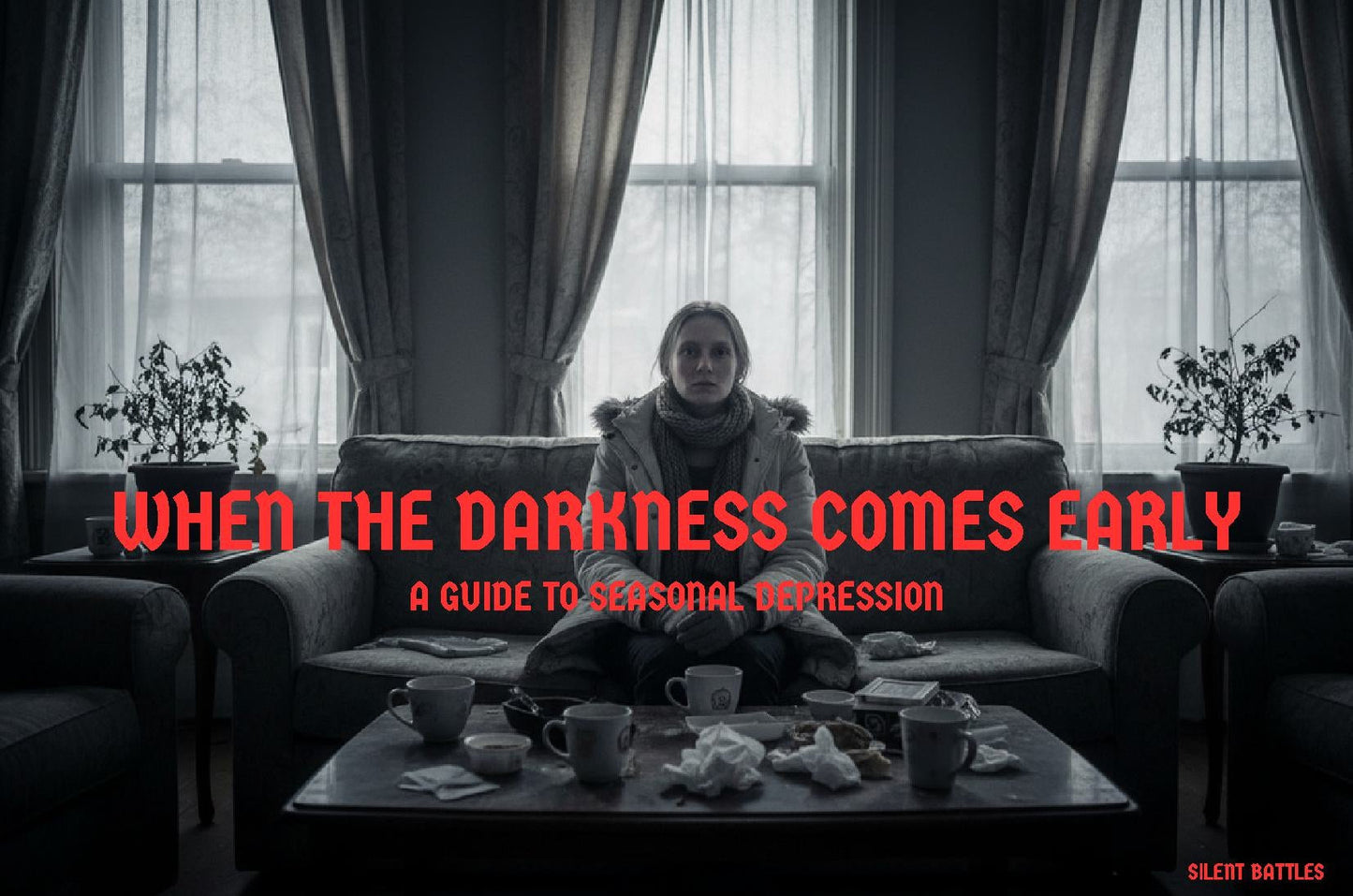
By December she was calling in sick to a job she used to love. She'd sit on her couch still wearing her coat — not because she forgot to take it off, but because taking it off felt like too much. Like it required something she didn't have anymore.
She wasn't lazy. She wasn't dramatic. She wasn't a "winter person" in the charming, cozy way she'd always told herself.
Something in her brain was genuinely shutting down with the light.
And nobody had ever told her that was a real thing that happened to real people.
She'd Google "why do I feel so bad in winter" and get articles about vitamin D and tips to "embrace the season." She'd try to explain it to her sister and watch her sister's face do the thing — the polite, slightly confused thing — that meant I hear you but I don't really get it.
She stopped trying to explain. She stopped answering the phone. She put her coat on and sat on the couch and waited for spring.
She was 34 when she finally had a name for it.
Seasonal Affective Disorder. SAD. A real diagnosis. A real neurological response to reduced light that affects an estimated ten percent of people in northern latitudes — and twice as many women as men.
Not a personality flaw. Not a preference. Not something to laugh off with a candle.
Something real. With real tools.
Amara still lives in Iceland. She still feels it coming every October. But now she knows what it is. And knowing — really knowing — changed everything.
This guide was written for everyone who dreads October. For everyone who becomes a different, emptier version of themselves when the days get short. For everyone who has ever sat on a couch in their coat and not known why.
You're not broken. You're not weak. Your brain is doing something real — and you deserve real tools.
What This Guide Will Do For You
By the time you finish this, you will:
- Understand what's actually happening in your brain when the seasons change — explained like a human, not a textbook
- Know why "just get outside more" is the most useless advice and what actually moves the needle
- Have a clear picture of what works — light therapy, routine, movement — and how to start when you have zero motivation
- Know how to explain this to people who've never felt it without wanting to give up halfway through the conversation
- Know what to do when spring comes and you still don't feel like yourself
- Have a plan to build before next winter hits — so you're not starting from zero again
This guide is a starting point, not a substitute for professional mental health support. If you or someone you know is in crisis, please call or text 988 (Suicide & Crisis Lifeline — US) or your local crisis line.
Best decision I made. I was prepared this year in a way I've never been before. The difference was noticeable. Thank you.
The named method at the end gave me something to come back to every year. I've already shared it with my doctor.
People always minimize seasonal depression like it's just winter blues. This guide treats it with the seriousness it deserves and gives real evidence-informed tools. Appreciated.
I've had seasonal depression for fifteen years and every year I'm caught off guard by it. This guide helped me build a plan before the darkness hits so I'm not starting from zero. Game changer.