
The Empty Chair — A Guide to Grief and Depression
The Empty Chair — A Guide to Grief and Depression
4.75 / 5.0
(4) 4 total reviews
Couldn't load pickup availability
The Empty Chair
A Guide to Grief and Depression
Kofi's Story
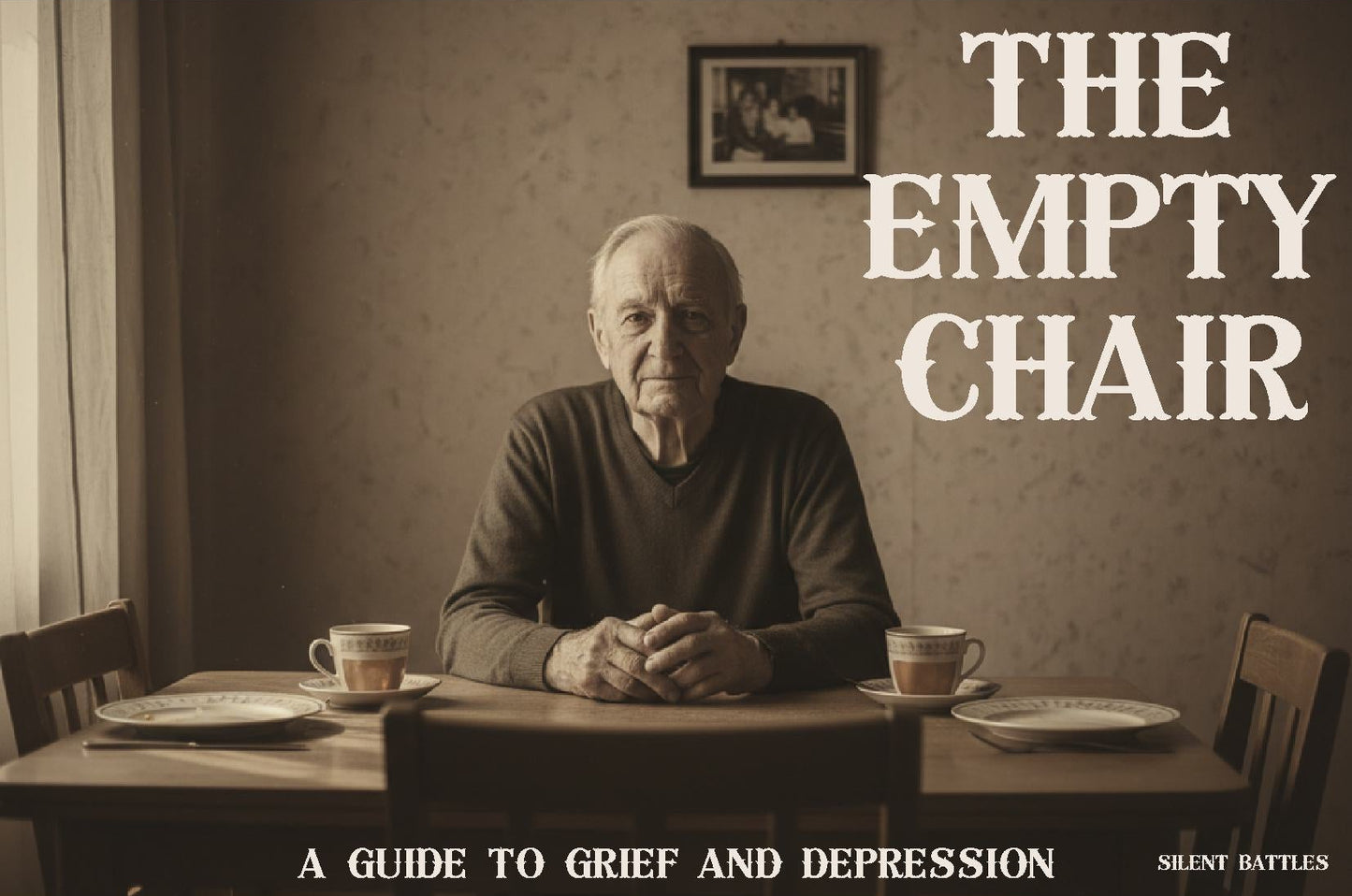
Kofi still sets the table for two.
He knows he shouldn't. His daughter keeps telling him. But every morning in his small home outside Kumasi, Ghana, he puts out two cups, two plates — and then he sits down alone and stares at the one across from him. The one that's been empty for fourteen months.
His wife of 41 years died on a Tuesday. Quietly. In the same bed they'd shared since 1982.
And Kofi, who had survived drought and debt and things he never talked about, found that he could not survive the silence of a house that used to have her in it.
He didn't call it depression. He called it missing her.
But it was both.
He still woke at the same time every morning — habit, or maybe hope. He still made two cups of tea. He still reached for her side of the bed in the dark before he remembered. And then he remembered. Every morning, he remembered.
His daughter visited on Sundays. His neighbors brought food. People said the right things — she's at peace, she lived a full life, time will heal — and Kofi nodded and thanked them and felt something inside him go very quiet and very far away.
Not sad, exactly. Not anymore. Just... absent. Like the part of him that knew how to be a person had been in that bed too, and had gone with her.
He didn't tell anyone that part. He didn't have the words for it. And besides — he was supposed to be the strong one. He had always been the strong one.
Nobody told him that grief can rewire you. That it can take something that used to feel like you and make it feel like a stranger. That missing someone and being depressed can live in the same body at the same time and make each other worse.
Nobody told him he was allowed to get help for both.
Kofi still sets the table for two. But some mornings now, he sits down and talks to her out loud. Tells her about the day ahead. Tells her what their daughter said on Sunday. Tells her he misses her in the specific, ordinary ways — the sound of her in the kitchen, the weight of her beside him, the way she laughed at things he didn't think were funny.
And somehow, that helps.
This guide was written for everyone staring at an empty chair. For everyone whose sadness has stopped feeling like sadness and started feeling like nothing. For everyone who has been strong for so long they don't know how to ask for help with the one thing that has finally broken them.
You are allowed to grieve as long as you need to. You are also allowed to get help. Those two things can exist at the same time.
What This Guide Will Do For You
By the time you finish this, you will:
- Understand the difference between grief and depression — and why it matters that you know
- Know why "time heals" is only half true, and what actually helps the other half
- Have real guidance for how to keep living when the person who made life feel worth living is gone
- Know what to do when the people around you have moved on but you haven't
- Understand the guilt of having good days — and why good days don't mean you've forgotten them
- Have a path back to yourself that doesn't feel like leaving them behind
This guide is a starting point, not a substitute for professional mental health support. If you or someone you know is in crisis, please call or text 988 (Suicide & Crisis Lifeline — US) or your local crisis line.
Everyone in my group read it. We spent our whole session talking about it. The facilitator said it was one of the best resources she'd seen on grief and depression together.
I was worried I was clinically depressed after losing my mom. This guide helped me understand the difference — and when one becomes the other. That clarity was exactly what I needed.
And felt better for it. This guide gave my grief somewhere to go. The opening story was so specific and so true that I felt like the author knew my father. Beautifully written.
My wife passed eighteen months ago. The holidays are unbearable. This guide understood grief in a way that most resources don't — not as something to get over but as something to learn to carry. I'm still learning. This is helping.